
Weekly Agenda Template
Type in the week’s events — meetings, lectures, shifts, workouts, appointments — and this weekly agenda template lays them out on an hour-by-hour grid with a colour for each category. It flags any clashes, adds up how many hours go to work, study, family and exercise, and lets you print a clean agenda or add the events to your calendar.
- Free to use
- No sign-up
- Runs in your browser
Weekly agenda builder
Weekly Agenda Printables
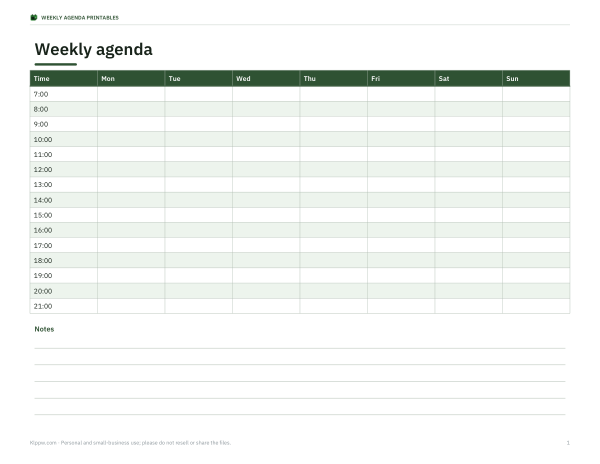
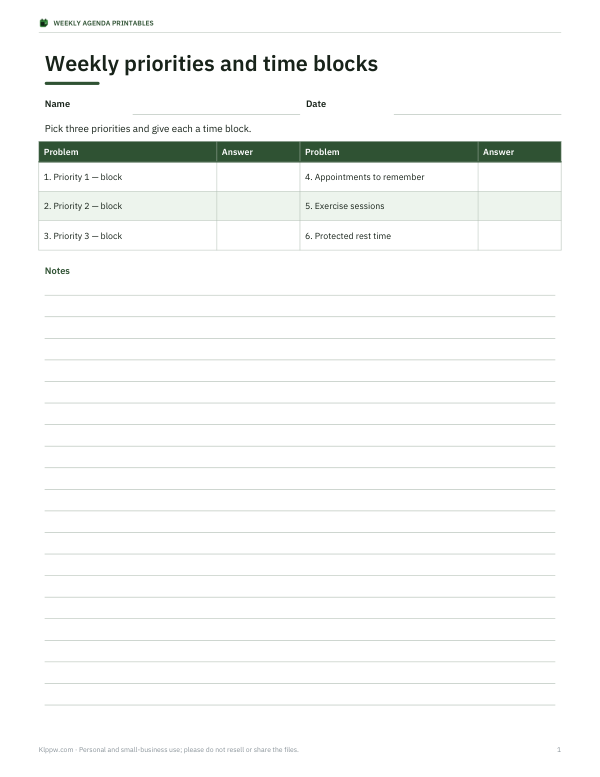
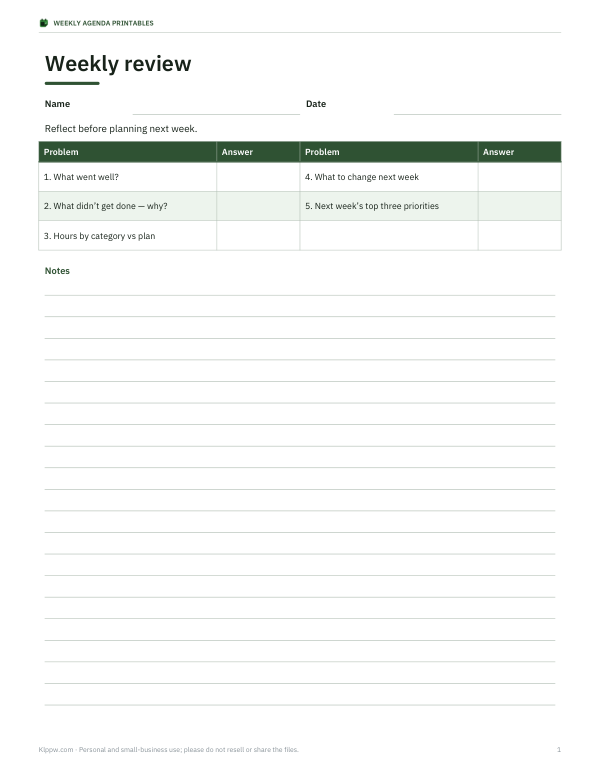
Printable weekly agenda set: hour-by-hour weekly grid, priorities and time-blocking sheet, a weekly review template, and an Excel time tracker that totals hours by category.
- Hourly agenda (PDF/DOCX)
- Priorities sheet (PDF, DOCX)
- Weekly review (PDF, DOCX)
- Time tracker (XLSX)
Formats: PDF, DOCX, XLSX. Instant download after payment (link valid 72 hours, up to 5 downloads). AI-assisted: the templates were drafted with AI help and reviewed and laid out before publishing.
$3.00 USD, one-time 4 files · about $0.75 each
- Instant download
- 7-day refund
- Secure checkout by Stripe
7-day money-back guarantee. Full refund within 7 days of purchase, even after you download.
Free sample: Weekly Hourly Agenda (PDF, 58 KB)
Full refund within 7 days — see the refund policy and license.
Free printables
Single sheets you can print right now, no sign-up. The full pack adds every sheet in one download plus the editable files.
 Printable Weekly Time Tracker
Why use a weekly agenda
A weekly agenda shows your fixed commitments in time — not just a list of what to do, but when you are actually busy. Seeing the week on an hour grid makes it obvious where the free blocks are for focused work, exercise or rest, and where the week is overloaded before it starts. Many time-management methods, from time blocking to a weekly review, begin with exactly this picture.
How to use the agenda builder
- Give the week a title and set the hours the grid should show.
- Type one event per line: day, start–end time, title and category — for example “Tue, 10:00-12:00, Lecture, Study”.
- Times can be 24-hour (14:30) or 12-hour with am/pm (2:30pm).
- Events in the same category share a colour; overlapping events sit side by side and are listed as clashes.
- Check the hours per category, then print the agenda or download an .ics file to import into your calendar app.
The events are processed in your browser and aren’t uploaded. The calendar file places them in the coming week.
Worked example
A part-time student who also works enters ten events: meetings and an office day for work, a lecture and study group, a dentist appointment, a gym session and a run, football with the kids and a meal-prep session on Sunday. The builder shows 21 scheduled hours: 10 for work (about 48%), 4 for study, 3 for personal, 2 for exercise and 2 for family. It flags one clash on Wednesday, where a 4:30 pm project call overlaps the office day that runs to 5 pm, prompting them to move the call to the morning.
Choosing categories
| Category | Examples |
|---|---|
| Work | Meetings, shifts, deadlines, commute |
| Study | Lectures, seminars, revision blocks |
| Personal | Appointments, errands, admin |
| Family | School runs, activities, meals together |
| Exercise | Gym, runs, classes, walks |
| Rest | Protected downtime — schedule it too |
Keep to five to eight categories; more colours make the grid harder to read.
Time-blocking tips
- Put fixed commitments in first, then block time for your most important task each day.
- Schedule deep work when your energy is highest — for many people, the morning.
- Leave buffers of 15–30 minutes between meetings for travel and overruns.
- Group small tasks such as email into one or two blocks.
- Plan rest and exercise as real appointments, not leftovers.
- Review the week on Friday or Sunday and adjust next week’s agenda.
Reading the category totals
The hours per category turn a busy week into numbers you can compare. If work takes 60% of your scheduled time but you wanted to prioritise study, the agenda shows it immediately. Tracking the same categories over several weeks — for example in the printable weekly review sheet — reveals patterns such as meetings creeping up or exercise slipping.
Weekly agenda vs to-do list
A to-do list says what needs doing; an agenda says when. Tasks without a time slot tend to slide, while an agenda can become unrealistic if it has no slack. Many people use both: a short list of priorities for the week, and an agenda where the most important of those priorities get a specific block of time.
Planning a realistic week
Most people overestimate what fits into a week. A useful check is to add up the scheduled hours and compare them with the waking hours available: a 7 am to 9 pm day is 14 hours, or 98 hours a week, but meals, travel, chores and rest take a large share. If your agenda is already full before you have added focused work or exercise, something needs to move, shrink or be declined. Leaving 20–30% of your working hours unscheduled gives room for the unexpected.
Agendas for shared schedules
Families, flatmates and small teams can use the same format to see who is busy when. Use one category per person instead of per activity, and the colours show at a glance who has the school run, the late shift or a free evening. Print it for the fridge or share the calendar file so everyone has the same plan.
Common event formats
| You type | Read as |
|---|---|
| Mon, 9:00-10:30, Meeting, Work | Monday 9:00–10:30 |
| Tue, 2pm-3pm, Dentist, Personal | Tuesday 14:00–15:00 |
| wednesday, 18:00-19:00, Yoga, Exercise | Day names can be full or short, any case |
| Fri, 12-13, Lunch with Sam, Personal | Hours without minutes are fine |
Importing into your calendar
The .ics file works with Google Calendar, Apple Calendar and Outlook: open it or use the calendar’s import option. Each event is added once for the coming week at the times you entered, in your device’s time zone. Review the events after importing, because re-importing the same file can create duplicates.
Frequently asked questions
How do I make a weekly agenda?
List your events with day, time, title and category; the builder arranges them on an hour grid.
Can I use 12-hour times?
Yes, like 2:30pm, or 24-hour like 14:30.
Does it show conflicts?
Yes, overlapping events are listed as clashes and drawn side by side.
Can I export to Google Calendar?
Yes, download the .ics file and import it.
Can I print it?
Yes, as a colour-coded weekly grid.
Is my schedule uploaded?
No, everything runs in your browser.
What does the clash warning mean?
Two events on the same day overlap in time.